Phase Locking
Introduced in Models optimized for real-world tasks reveal the task-dependent necessity of precise temporal coding in hearing
Phase locking is approach for signal processing in [[Spiking Neural Networks]]. In humans, auditory nerves fire in phase with the incoming sound waves, which requires modulation of the spike rate at smaller intervals than action potentials. The same mechanism can be used in SNNs to improve sound localization and voice recognition in noisy real-world environments.
The paper is psychologically motivated. It is not trying to introduce a new mechanism for machine learning, rather its motivation is to explain the phase-locking mechanism in human hearing. It shows that an observer optimized in real-world environments with human-like hearing will benefit from phase-locking of auditory nerves. By manipulating the networks constraints, a relatively simple model can produce very human-like behavior, suggesting these constraints also played an evolutionary role in the human body. The same constraint-manipulation would not be possible in humans (e.g. changing the phase-locking rate of nerves, depth of cortical processing, etc.).
Phase Locking Limit
 |
 |
|---|---|
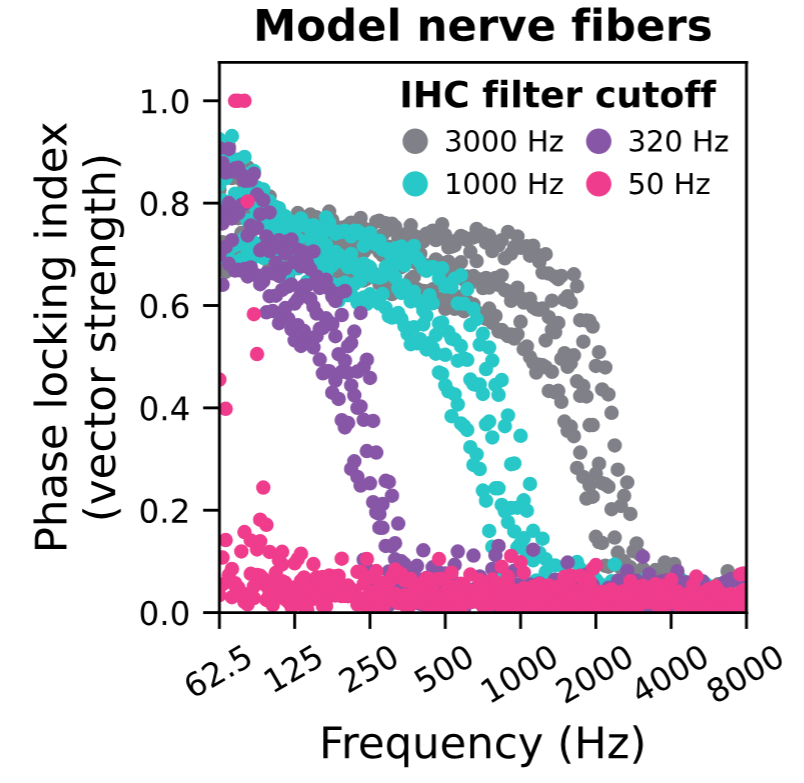
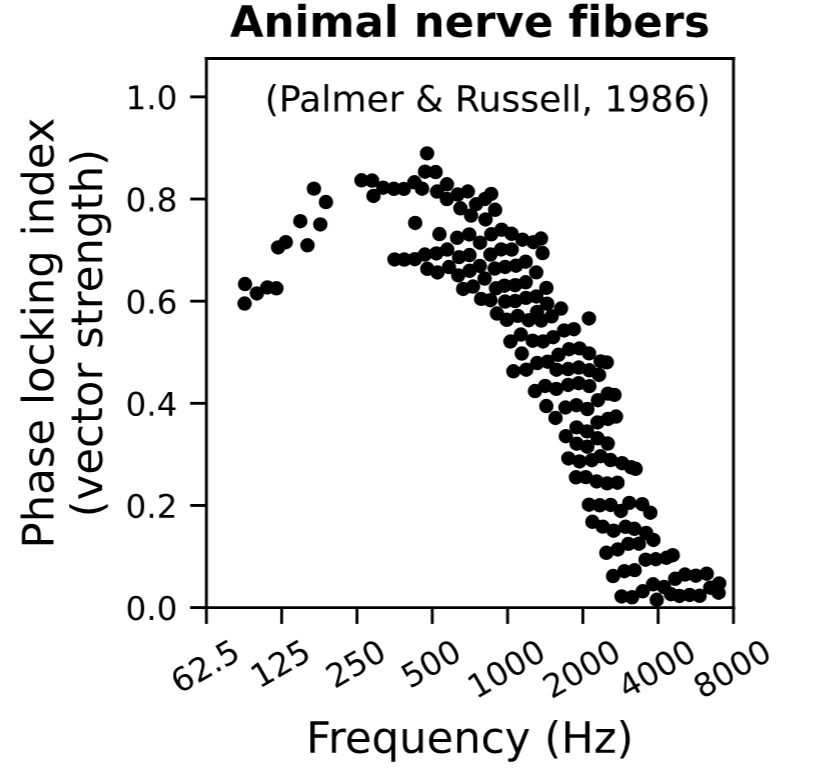
The phase locking limit represents the upper-end of frequencies for which locking behavior occurs. The perception limit might be much higher.
In humans, the phase locking limit of the auditory nerves is 3000Hz, the perception limit ca. 20000Hz. Interestingly, the phase locking limit in the binaural circuits of the brainstem is only 1000Hz, suggesting a degradation of the signal between auditory nerves and brainstem.
The phase-locking limit is the major constraint manipulation of the study, testing cutoffs at 50Hz, 320Hz, 1000Hz and 3000Hz.
Benefits for Hearing Tasks
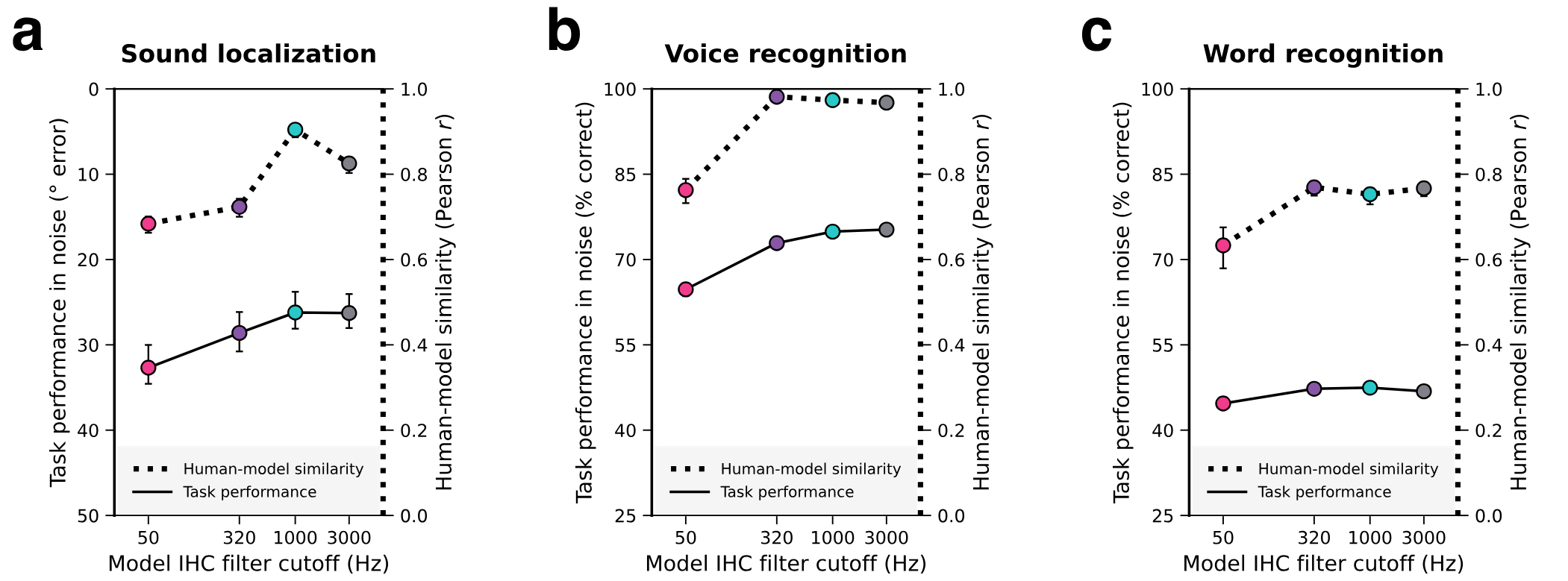 Performance improvements can be observed for:
- Sound Localization: up to 1000Hz.
- Voice Recognition: up to 320Hz.
- Word Recognition: no/minimal benefit.
Performance improvements can be observed for:
- Sound Localization: up to 1000Hz.
- Voice Recognition: up to 320Hz.
- Word Recognition: no/minimal benefit.
The authors speculate the reason for the performance benefits tapering off with increasing phase locking limit might be the naturalistic soundscape and the ratio of frequency to head width becoming too large.
For as to why human auditory nerves have a phase-locking limit of 3000Hz, when 1000Hz are already optimizing performance, the authors suggest the delayed interaural integration as the reason. The auditory signals per ear are not directly integrated, but passed through several stages of monoaural processing before being combined. This degrades the phase locking limit of both signals to 1000Hz when arriving at the brainstem. A direct synaptic links between both auditory cortices would allow for early integration and a lower phase locking limit in the auditory nerves. The authors however assume that the more extensive pre-processing of the auditory signals before integration proves beneficial in noisy environments.
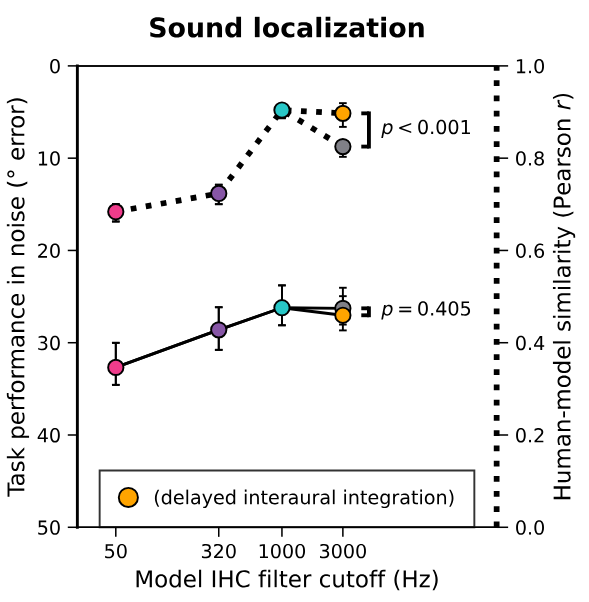 To provide evidence for that assumption, the authors add a similar delayed interaural integration in the model, and show more human like hearing behavior for the model at 3000Hz phase locking.