Roadmap
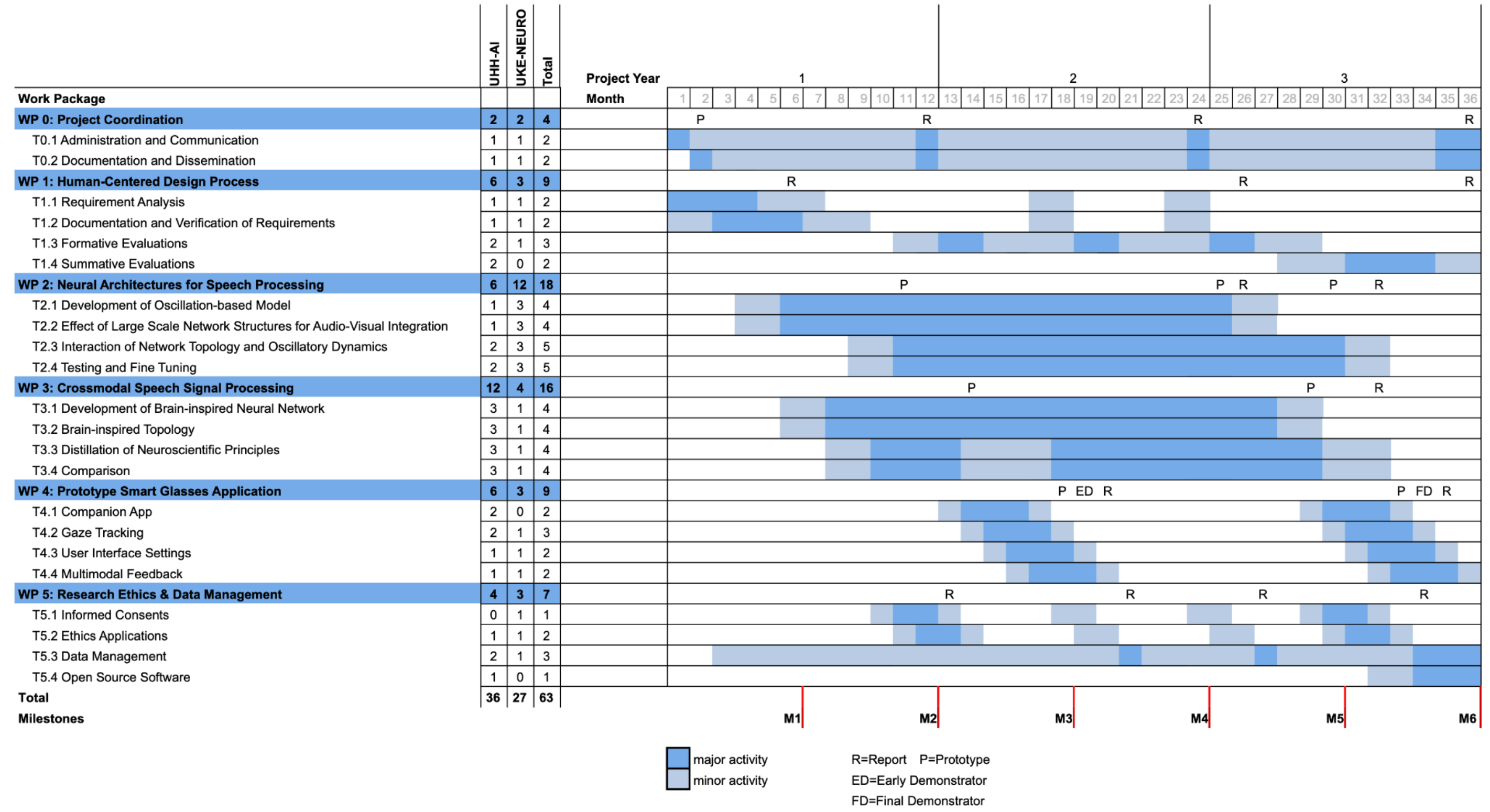
Key Milestones
| Month | Milestone |
|---|---|
| 6 | Requirement Analysis (Documentation and Verification) |
| 12 | First models of neural architectures for speech processing (Oscillatory and Topology) |
| 12 | First evaluations of bio-inspired neural networks |
| 14 | Companion App / VR Testbed |
| 18 | Early demonstrator of Smart Glasses |
| 24 | Neural architecture are integrated in crossmodal speech signal processing |
| 30 | Summative evaluation of Glasses |
| 36 | Final demonstrator and project finalization |
Initial Steps
- Create initial literature overview
- Keep it very broad, don't dive into papers
- Existing Glasses
- Libraries and frameworks
- Cocktail Party Problem
- Initial Hypothesis and Goals for dissertation
Phase 1: Entrypoint, Glasses with SE via Beamformer
- Data simulation and virtual test-bed
- Research material/experimental setup
- Comparability to other papers with similar goals
- UX vs experimental flexibility (tech should be quickly adaptable)
- Question: Embedded/on-device vs. external computer
- How to integrate
- microphone array
- speakers (in-ear vs in-frame)
- gyroscope
- eye tracking
- cameras (RGB, infrared, depth, …?)
- Research algorithmic setup
- Delay Beamformer, MVDR Beamformer
- Wiener Filter
- What other signal input can be used?
- Step 1: Build MVP, using head direction for beamforming
- Step 2: Integrate eye tracking, using eye focus for beamforming
Phase 2: Audio-only Neural SE
- Progress from purely algorithmic approaches to neural SE
- Use audio + view direction for SE
- SP lab research by Kristina Tesch
- Bio-inspired approaches like LinOSS (UKE)
Phase 3: Audio-Visual Fusion SE
- Augment glasses with outward facing cameras
- Use audio-visual fusion techniques for SE
- Which modality in noisy environments?
- Structured Light (e.g. RGB/infrared grid)
- Time-of-Flight (lidar)
- Which models?
- Mathematical vs bio-inspired